
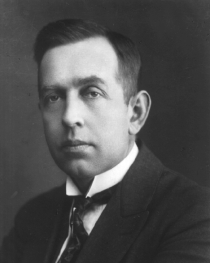
This year marks 125 years since the birth of Jónas Jónsson frá Hriflu, who was born on 1 May 1885. He was one of the most controversial and most respected Icelandic politicians of the last century. Jónas made his mark in other fields too and was a great pioneer in education. He was a proponent of radical ideas in teaching, which he described in his article on Lýðskólinn í Askov (the Askov folk high school) in Eimreiðin in 1909. In the article Jónas says, among other things:
“Most of the pupils were poorly prepared, and quite often had a dislike of books and book learning from their primary school years. The lectures were meant to refresh and enliven them and to wipe out unpleasant memories of learning by rote. If that succeeded, the work was half done. The next stage was to teach the pupils to work on their own, and the discussion classes were meant for that. The teacher then went through what he had said in the lectures, or what the boys had read themselves. He did not test them, but went over the main points. Each then brought what he remembered and had noticed; the conversation then led on word by word, but if it strayed too far from the subject, the teacher steered it back onto the path, reminded them of some of what had been forgotten, and explained the most difficult points more fully. In the discussion classes the teachers found it easiest to get to know the pupils, to discover the best and most distinctive in them and then try to help them develop according to their nature and natural gifts.”
Jónas continued the debate on education in articles in Skólablaðið in 1911–1912, and in 1913 he published a notable article, “Nútíma hugmyndir um barnseðlið” (Modern ideas on the nature of the child), in the journal Skírnir.
Founding a co-operative college was one of Jónas’s causes, and he published an article on his ideas about teaching methods in Tímarit íslenzkra samvinnufélaga in 1917. There he says, among other things:
“On the shelves of the school library … are all the main sources needed for the studies, and many copies of the books that a whole class needs to use at the same time. Lessons are relatively few. The teachers give overview lectures and give the pupils short handbooks with detailed bibliographies for support. The students are then required to gather material from many sources on the main points of the teaching and write essays on it. Then the teacher reads through each essay with the student who wrote it, alone. Such teaching has proved successful everywhere. It accustoms pupils to working independently and to looking at things with their own eyes. The teacher’s task is to show the way, point to the sources and teach the novices to work methodically. Those who have learnt such working methods find it easier to get to the bottom of problems than those who are used to repeating thoughtlessly what they are told.”
Jónas is probably best known for his political work: he was one of the founders of the Social Democratic Party and the Progressive Party. He was Minister of Justice in one of the most active governments in Icelandic history, the minority government of the Progressive Party in 1927–1931. For many years he was the party’s leader and one of the main leaders of the co-operative movement.
Jónas wrote a great many articles in the journal Réttur, Tímarit samvinnumanna and Tíminn. He also wrote many articles in Skinfaxi, the paper of the Icelandic Youth Association. Skinfaxi was one of many journals he edited; Skinfaxi was steeped in the ideology of the independence struggle no less than in the youth associations’ ideas of a healthy mind in a healthy body. The journal published much social criticism, and in an article in it in 1913 Jónas wrote these classic words: “We must not forget that a group of swindlers has formed in this country, who mainly make a living by founding companies, bankrupting them and picking up the pieces. These men are free of most moral restraints. Greed for money drives them on; prison is the only thing they avoid. That is why they use their cunning to cheat within the law; such robbers are the most harmful men of our time.”
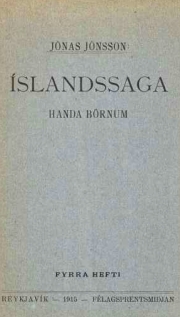
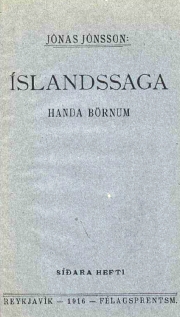
Jónas Jónsson frá Hriflu was a controversial politician, but although it is long since he died, an average of about two articles a month appear in Icelandic journals and newspapers in which Jónas is mentioned. He was a teacher by training and worked as a teacher and headmaster in the years when he was not a member of parliament or a minister. He wrote one of Iceland’s longest-lived textbooks, Íslandssaga handa börnum (A history of Iceland for children), which was taught in the country’s primary schools for seven decades; it was first published in 1915. The book can be seen as a monument to the generation that carried Iceland’s struggle for independence, and it is the Highlight of the month for May. Jónas died in 1968.
 |
 |
| Íslandssaga handa börnum, part one (PDF – 47 MB) |
Íslandssaga handa börnum, part two (PDF – 40 MB) |