
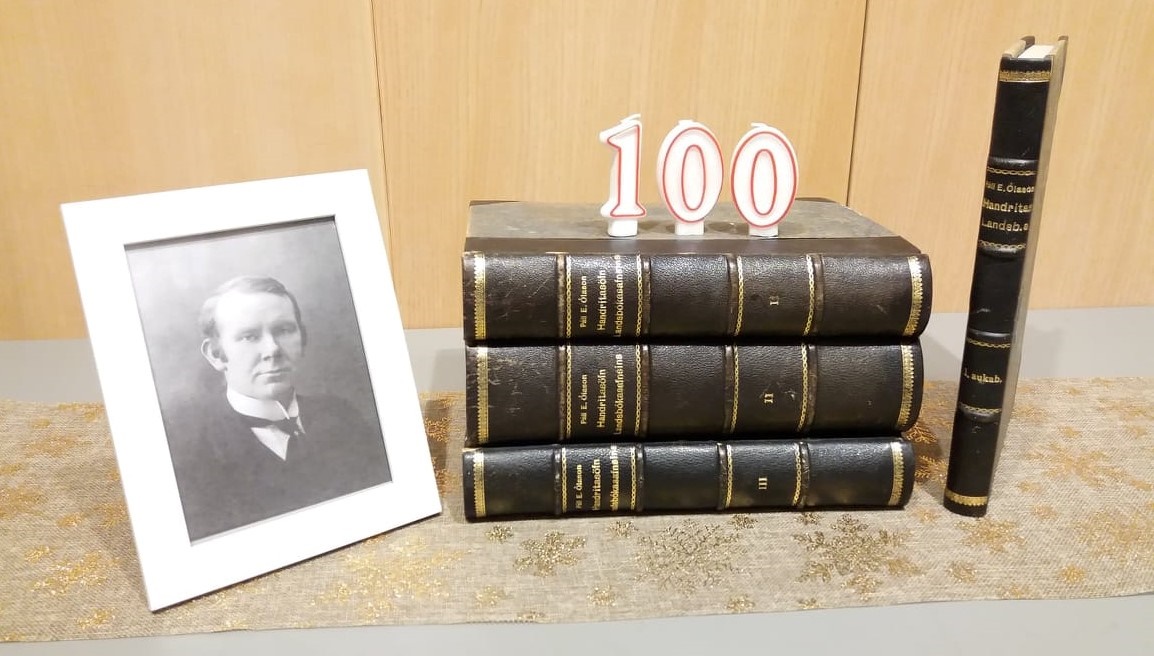
It is now 100 years since publication began of the catalogue of the National Library’s manuscript collection: the first part of the catalogue came out in December 1918. Tíminn wrote on 28 December: “Until now the manuscript collection has been a hidden treasure. No one has known fully what was to be found there. The consequence [was], of course, that it was largely unused. With the publication of the catalogue the general public will have easy access to it, and it can be taken as certain that, as with the old charters, many gaps in the country’s history can be filled and errors corrected. The book is very well produced. It says what needs to be said and nothing more. When a clear table of contents comes with each volume, I would guess that a great many people will want to look into the treasure. To every single Icelander who loves the history of his country and enjoys studying it, this book will be the most welcome of guests. It is the key to a new world.”
The history of the manuscript catalogue’s publication can be traced back to 1912. On 13 November that year Jón Jacobson, then National Librarian, wrote to the Government Offices with proposals for changes to the Library’s funding in the budgets for 1914 and 1915, in which he named various things that needed to be done. “But the most keenly felt of all is the lack of a scholarly catalogue (systematisk Katalog) of the manuscript collection, this treasure chest of Icelandic historical lore, poetry etc., which is still a half-hidden treasure to those who want to use it.” (Landsbókasafn Íslands 1818–1918. Minningarrit, p. 240). Others were also considering the need for a good catalogue of the collection, for a month and a day later Bogi Th. Melsteð wrote an article in Ísafold, published on 11 January 1913: “Worst of all, though, is that there is no catalogue of the manuscript collection in the National Library, and much of its collection of letters is not in any order, let alone more. The Danes and the Swedes have had detailed catalogues printed of all the Icelandic manuscripts in their libraries; Dr Kr. Kålund’s manuscript catalogue in particular is quite excellent and the best possible model for the National Library. Wherever one goes, there are catalogues of Icelandic manuscripts, except in the National Library. Icelanders should not lag behind other nations in this. A catalogue of the manuscripts in the National Library should be compiled and published as soon as possible, so that they can be used and people can see what is there. Until this is done, it can truly be said that no nation in the wide world shows Icelandic manuscripts as little respect as the Icelanders in Iceland. This is a disgrace.” (Ísafold, 11 January 1913, p. 10.)
The call from Jón and Bogi found support among the authorities: that same year it was decided that Páll Eggert Ólason would catalogue the National Library’s manuscript collection (alongside work on cataloguing printed books), and, as mentioned above, the first part of the first volume came out before Christmas 1918. The aim had been to reach that milestone in the Library’s centenary year. Páll himself had worked on transcribing Icelandic manuscripts kept abroad, which had been lent to the National Library for that purpose in 1906–1913, and this made him aware of the need for careful catalogues of the manuscripts. The publication marked a turning point. In 1924 Sigurður Nordal wrote: “The year the last part of this catalogue comes out, a new period begins in research into Icelandic culture and history in later centuries. Everyone who loves Icelandic studies will wish that year to come as soon as possible.” (Lögrétta, 2 April 1924, p. 3.). The catalogue was completed in 1937; it ran to three volumes of more than 2,000 pages, with descriptions of about 8,600 manuscripts.
The manuscript catalogues were a great achievement by Páll, though he was criticised for being rather quick to attribute hands to particular people (Jón Helgason, Handritaspjall, p. 118) and for not making women’s part in the manuscript heritage visible enough (Guðný Hallgrímsdóttir, Sagan af Guðrúnu Ketilsdóttur, pp. 15–31.) When he finished the work, he himself wrote that the National Library held “far too many worthless manuscripts”, but also said that “all catalogues are only a guide.” (Volume III, pp. vii and xi). Be that as it may, the catalogue is indispensable for getting to know the National Library’s manuscript heritage, as the historian Þorkell Jóhannesson wrote in 1948 in the preface to his book Stiftamtmenn og amtmenn á Íslandi 1750–1800 (Governors and District Governors in Iceland 1750–1800): “The manuscript catalogue is one of the most useful works ever done for Icelandic studies, and can hardly be thanked enough, as anyone who needs to look for material in the manuscript collection will confirm.” (p. 3).
The holdings of the manuscript collection grew every year, so four supplementary volumes were published in the second half of the twentieth century. Páll Eggert compiled the first supplementary volume, published in 1947 (196 pages); supplementary volume II came out in 1959, edited by Lárus H. Blöndal (198 pages), with a list of vellum leaves by Jakob Benediktsson (42 pages); supplementary volume III came out in 1970, edited by Lárus and Grímur M. Helgason (242 pages); and supplementary volume IV in 1996, on the 150th anniversary of the Manuscript Collection, edited by Grímur M. Helgason and Ögmundur Helgason (416 pages).
The catalogues can now be found on Bækur.is. On the Manuscript Collection’s website there are also files in which the names of people and the subject keywords have each been gathered into separate documents, which makes searching much easier. Work is also under way to transfer the information in the printed catalogues to Handrit.is.
The picture shows the three main volumes, published 1918–1937, and the first supplementary volume, published in 1947. Páll Eggert watches over his works in the picture.