
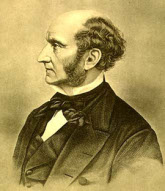
The book On Liberty (Um frelsið in Icelandic), by John Stuart Mill (1806–1873), is one of the founding works of Western democratic thought; Mill was one of Britain’s most influential philosophers and economists. His book Principles of Political Economy (1848) succeeded The Wealth of Nations, by Adam Smith, as the most important textbook of economics, and remained so for half a century. Although Mill was a liberal, he was critical of Smith’s theories.
Mill held that the distribution of income in the economy was man-made and not subject to inevitable laws of nature. He accepted various arguments of the socialists and their criticism of capitalist society. Mill also argued for the protection of nature, appealing to the value of natural beauty.
Mill’s On Liberty, first published in 1859, is, as said above, one of the founding works of Western democratic thought. The book expresses an idea that can be traced back to John Locke, that the sovereignty of the individual is above the sovereignty of the state, and back to the utilitarianism of Jeremy Bentham, which Mill refined.

Mill was influenced by the Frenchman de Tocqueville and put great emphasis on the decentralisation of power and the independence of local communities. The main message of On Liberty, however, is its argument against the tyranny of the majority and for the right of minorities to keep their views in a democratic society. Mill also argued that individual liberty is limited only by the condition that people’s actions do not harm others (called “the harm principle”). As long as individuals do not harm others by their actions, society has no right to interfere with them.
In his autobiography Mill mentions that his wife, Harriet Taylor, had a decisive influence on the thinking in the book.
The editor Jón Ólafsson translated the book, which was published in 1886, a time of great awakening in political debate in Iceland. Jón Ólafsson was twice convicted for what he wrote in Icelandic newspapers and fled the country as a result.
Um frelsið, John Stuart Mill’s On Liberty in Jón Ólafsson’s Icelandic translation (PDF, 12 MB)