
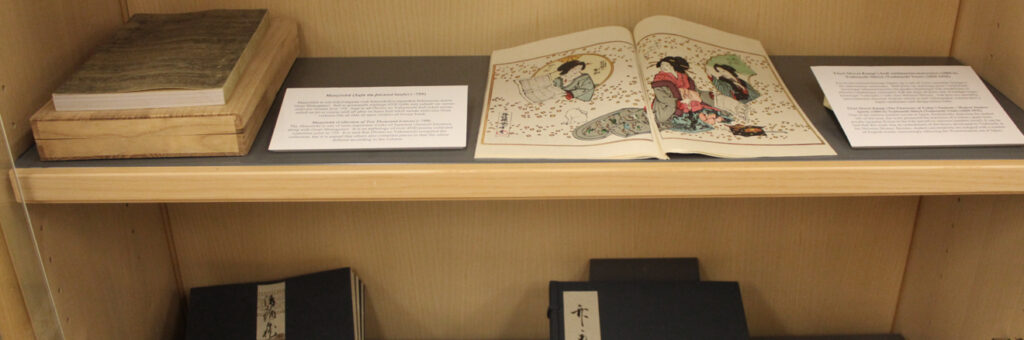
A Japanese couple, Eiko and Goro Murase, retired teachers, came to Iceland in May 2003 to see a solar eclipse; they have travelled widely for that purpose. They were greatly taken with the beauty of the country and the friendliness of the people. After returning home they decided to give the Japanese section of the Faculty of Humanities at the University of Iceland Japanese books, both classical and modern literary works. They are fine and beautiful facsimiles, from the beginning of the 8th century to the 20th century, and are kept here in the Library. The aim of the gift is to encourage young Icelandic students’ interest in Japanese language and culture. The couple also hope that the friendship between Iceland and Japan will continue to grow.
For the Japanese, literature has always meant more than the surface meaning of the words. In the Heian period, from the ninth century to near the end of the twelfth, it was held at court that a person’s handwriting, the way they formed the characters on the page, opened a window into their soul. Love letters (or letters between would-be lovers) were scrutinised for meaning beyond the material: the handwriting, the thickness of the ink, the use of space, the kind of paper – everything spoke for itself. Writing was at once visual and oral. Reading was also closely tied to writing, since without printing even great works such as the famous Tale of Genji had to be copied by hand.
In the Edo period (17th–19th centuries) printing became widespread, but readers’ wish to “read” meaning in the handwriting meant that a cursive script continued to be used even in print. In this period many literary works contained illustrations, sometimes by the authors themselves, but more often by professional artists. This complex interplay between text and illustration introduced many new ways of reading and opened the texts to readers with different levels of education. The well-known Japanese love of comics (manga) is perhaps only a continuation of these forerunners of modern ways of reading.
Our experience today of reading classical Japanese literature in printed text is quite different from how these texts were originally read and enjoyed when they were written. Publishers in Japan have produced luxury editions of famous works that faithfully reproduce the original calligraphy and illustrations. This exhibition gives an insight into the visual wealth of Japan’s literary heritage through facsimiles of some of its best-known masterpieces
Exhibition panels (PDF, in Icelandic)