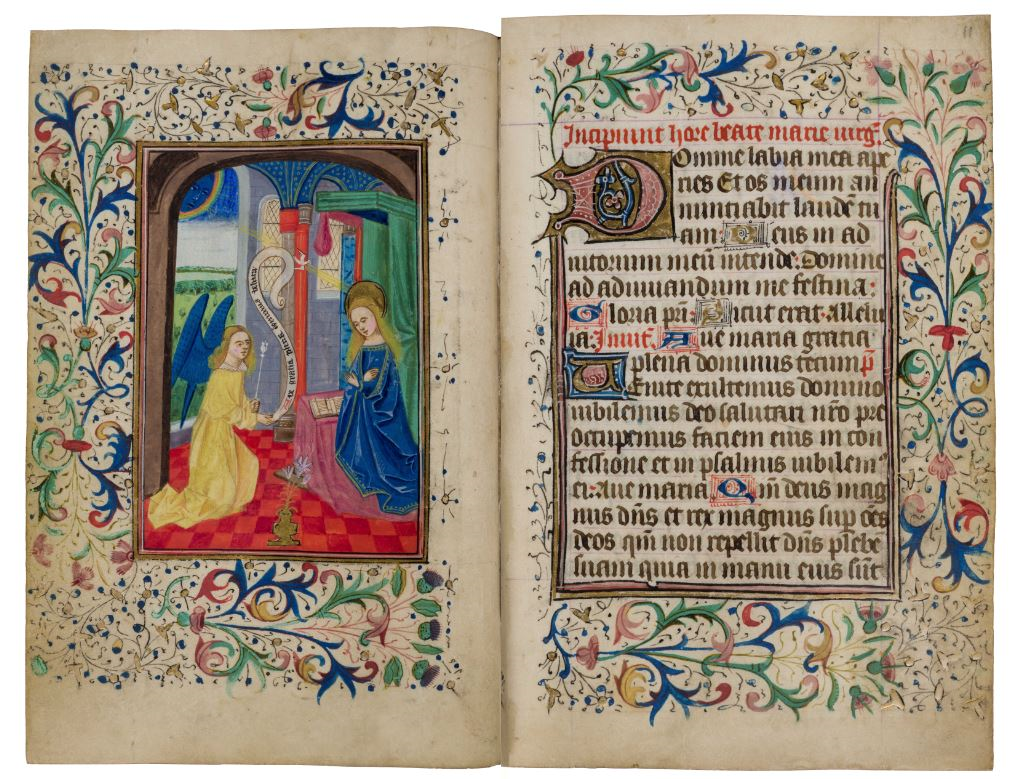
One of the most loyal supporters of the National Library was the American philanthropist and librarian Willard Fiske (1831–1904). During his lifetime, he donated over 1,500 books to the library, but later bequeathed a large portion of his books to the library in his will, and his bequest included over 2,500 volumes, many of which are valuable and rare. The gift arrived at the library soon after his death, but was not unpacked until after the collection was moved to the Museum Building in 1908. It was recently discovered that among the books that the library received from Fiske's library were four foreign manuscripts, all of which are unique.
One of these manuscripts, Lbs 5336 8vo, is a book of hours written on parchment, probably in the 15th or 16th century. The manuscript contains the Hours of the Cross and the Hours of Mary in Latin. The hours are: ad Laudes, Primam, Tertiam, Sextam, Nonam, Vespers, Completorium. The manuscript is 69 leaves long, 18.6 x 12.5 cm in size. It is beautifully decorated and gilded, with initials in many places and at the beginning of each hour there are decorative panels and full-page illustrations, seven in total. It is obvious that much has been spent on the production of this book. It is bound in a leather binding that probably dates from around 1900, but embedded in it are printed decorative parchments from an older binding. The leaves of the manuscript are gilded, which was probably made at the same time as the manuscript was rebound. Nothing is known about the history of the manuscript, its author or its owners, other than Willard Fiske. However, it most likely originated in Europe, as menses were mostly written in the area around the Netherlands. Many of them were written for women and it was common for them to receive such books as a wedding gift from their husbands. A number of menses are preserved in museums abroad, but no other complete menses are known to exist in Iceland.
Two of the manuscripts are in Ottoman Turkish / Persian and belong to the literary tradition of the Ottoman Turks. They are written in Arabic script and therefore read from right to left. The second of them, Lbs 5337 8vo, contains the “Diwan” (poetry collection) of Münirî Amâsî (d. 1520) and was probably written in the 16th or 17th century. On leaf 146r, at the beginning of the text, there is a decoration in gold, blue, green and red. In addition, there are gold frames around the text of the manuscript. The manuscript has 146 leaves, 16.9 x 11.4 cm in size. According to our sources, only three other manuscripts are known to contain the poetry collection. One of them is in the Vatican Library, another in the National Library in Vienna and the third in the University Library in Istanbul.
The other manuscript, Lbs 5338 8vo, contains an Ottoman Turkish–Persian dictionary entitled “Tuhfe-i Şâhidî” (The Gift of Şâhidî) and was compiled in 1514–1515 by the scholar İbrahim Şâhidî (1470–1550). “Tuhfe-i Şâhidî” is a well-known text, preserved in numerous manuscripts around the world. It is a kind of dictionary of poems, but such books were used as textbooks. The text is based on the poem “Mathnavi-ye Ma'anavi” written by the 13th-century poet Mevlana Celalüddin Rûmî. The manuscript is believed to have been written in the 17th century. Its text is written in black and red ink and is surrounded by gold frames. Outside the frame are explanatory notes to the main text. On page 28r there are decorations in gold, blue, red, yellow and pink. There are 28 pages in total, 20.4 x 12.4 cm.
The paper in these two manuscripts has a texture that is very different from that known in Icelandic (and Western) paper manuscripts. Starch has been applied to the paper and it has been polished with a smooth stone or other tool. This gives the paper an even and smooth surface that prevents the color used for the decorations from sinking into it, as is common in Icelandic paper manuscripts. The decorations are delicate and elaborate, and obviously made with great skill.
The fourth manuscript, Lbs 5339 8vo, is a gospel book in Armenian. The manuscript was completed in 1682, it has two scribes and is richly decorated. The main part of the manuscript, up to leaf 135v, is written by Petros Dpir, but he died and another scribe, the priest Kirakos, took over to complete it. Four full-page portraits of the evangelists precede each gospel and decorative panels at their beginnings. The manuscript is also decorated with initials with drawings of birds colored in pink throughout. The manuscript is bound in a printed leather binding that bears all the main characteristics of Armenian bookmaking. Holes can be seen in it that are probably the remains of silver ornaments that have been attached to the binding, which was common in Armenian manuscripts. The manuscript is 182 leaves long, 16.7 x 14 cm in size.
It is not known where or when Willard Fiske acquired these manuscripts, whether he purchased them or received them as a gift. However, it is known that in addition to being a great collector, Fiske was interested in Egypt and Egyptian culture and must have traveled there often. During his travels there, he came across various antiquities that he bequeathed to the National Museum of Iceland.[1] It is possible that Fiske acquired the manuscripts, with the possible exception of the chronicle, during such trips. Why Fiske bequeathed these exotic manuscripts to the National Museum is another mystery, but it is safe to say that they stand out from the rest of the museum's collection.
All the manuscripts have been photographed and are available at handrit.is. In the coming days, they can also be viewed in a display case in the foyer of the Icelandic Museum on the 1st floor.
The following individuals are thanked for providing various information, assistance, and good advice regarding the cataloging of these manuscripts: Alessandro Gori, Eva-Maria Jansson, Irmeli Perho, Nicholas Kontovas, Sigurður Stefán Jónsson, Sonny Ankjær Sahl, Svanhildur Óskarsdóttir, Zara Pogossian, and Özden Dóra Clow.
[1] Guðmundur J. Guðmundsson. “Egyptian objects in the death gift of Willard Fiske,” Annual of the Icelandic Antiquities Society 1995. Pages 49–74.